

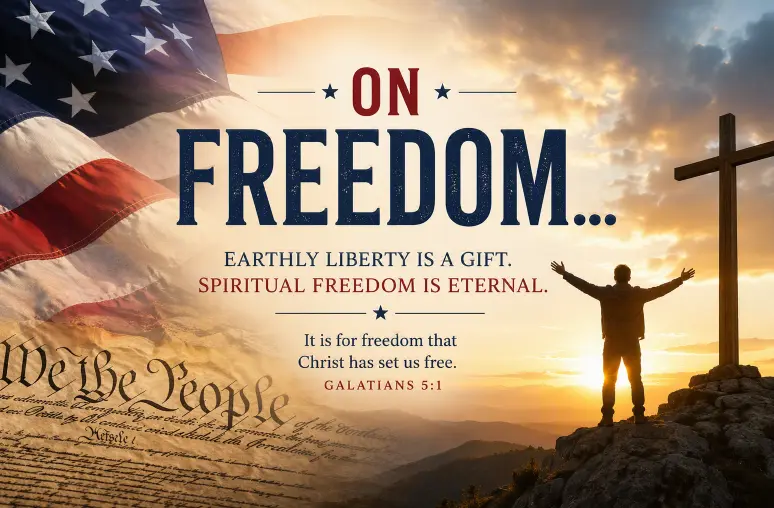
As America approaches its 250th year of independence, we find ourselves reflecting on a cherished ideal: freedom. We celebrate it in songs, protect it in laws, and pass it down as a sacred inheritance. But what is freedom, really?
We often use the words freedom and liberty interchangeably, but they are not the same.
Earthly liberty is a gift—one secured through constitutions, laws, wars, struggles, and sacrifice. Constitutions and just governments are instituted to protect our rights of worship, speech, personal security and mobility. Liberty shields us from tyranny and allows us to pursue happiness. But as valuable as it is, earthly liberty is also fragile. It depends on circumstances, governments, and geography. It can be restricted, revoked, or lost.
Spiritual freedom, however, is something altogether different. It does not come from man. It cannot be granted by governments or guaranteed by any constitution. True freedom comes only from God.
The Bible makes this unmistakably clear:
“It is for freedom that Christ has set us free. Stand firm, then, and do not let yourselves be burdened again by a yoke of slavery.” — Galatians 5:1
The freedom Christ gives is not political—it is personal and eternal. It is freedom from sin, from guilt, from shame, from hopelessness and fear.
Jesus declared His mission this way: “He has sent me to proclaim freedom for the prisoners… to set the oppressed free.” — Luke 4:18
This freedom reaches deeper than anything external. A person can be confined in a prison cell and still be fully free in Christ. Conversely, someone can live in the “freest” nation on earth and remain bound in fear, sin, and spiritual darkness.
Jesus said “You will know the truth, and the truth will set you free.” — John 8:32 (see also: On the Way and the Truth)
This is the dividing line—truth. Not opinion, not culture, not circumstance, but the truth of who Christ is and what He has done.
Through Him:
“Everyone who believes is set free from every sin…” — Acts 13:39
And because of Him:
“There is now no condemnation…” — Romans 8:1
This is complete freedom—freedom from the penalty and the power of sin. No human system can offer this.
But this freedom is not given for selfish living.
Scripture is equally clear:
“Do not use your freedom to indulge the flesh; rather, serve one another humbly in love.” — Galatians 5:13
“Live as free people, but do not use your freedom as a cover-up for evil…” — 1 Peter 2:16
True spiritual freedom transforms the heart. It frees us not just from something, but for something—to love, to serve, and to reflect Christ.
This is where earthly liberty finds its purpose.
Our freedoms are not ends in themselves; they are tools. They are opportunities entrusted to us—to serve others, proclaim truth, and advance the Gospel. (Your Reasonable Service)
The Apostle Paul not only understood this; he demonstrated it. Though often imprisoned, he never considered himself truly captive. Instead, he called himself a “prisoner of Christ.” In chains, he wrote letters that still change lives today. He shared the Gospel with Roman soldiers assigned to guard him.
His liberty was restricted, but his spirit was free.
“Now the Lord is the Spirit, and where the Spirit of the Lord is, there is freedom.” — 2 Corinthians 3:17
As we celebrate 250 years of American independence, let us give thanks for the gift of earthly liberty—but let us not confuse it with the greater gift.
Earthly liberty can shape a nation.
Spiritual freedom transforms a soul.
One can be taken away. The other is eternal.
So stand firm in the freedom Christ has given you.
Use your liberty to serve, to love, and to lift others.
And remember—
the greatest freedom we will ever know was purchased not by revolution,
but by redemption.